In a world of universal deceit, telling the truth is a revolutionary act, George Orwell

Indignez-vous ! Stéphane Hessel

“Le courage c’est de chercher la vérité et de la dire ; c’est de ne pas subir la loi du mensonge triomphant qui passe, et de ne pas faire écho, de notre âme, de notre bouche et de nos mains aux applaudissements imbéciles et aux huées fanatiques ”.” – Djordje Kuzmanovic


Affichage des articles dont le libellé est pipeline. Afficher tous les articles

dimanche 6 décembre 2015

Blog Post: Turkish head spinning antics

Head spinning madness on the Turkish frontier

Update on Turkey’s intransigence and duplicitous understanding of sovereignty over this weekend: this time, Turkish troops have gone into Northern Iraq.


Turkey will have a permanent military base in the Bashiqa region of Mosul as the Turkish forces in the region training the Peshmerga forces have been reinforced, Hürriyet reported.
The deal regarding the base was signed between Kurdistan Regional Government (KRG) President Massoud Barzani and Turkish Foreign Minister Feridun Sinirlioğlu, during the latter’s visit to northern Iraq on Nov. 4.

 http://www.hurriyetdailynews.com/turkish-military-to-have-a-base-in-iraqs-mosul.aspx?pageID=238&nID=92113&NewsCatID=352

Although it appears that the Iraqi Prime Minister Haider Al Abadi isn’t in the loop on this deployment:“We did not ask any country to send foreign ground troops, and we will treat any sent as a hostile act.”  The Iraqi authorities called on Turkey to withdraw immediately from Iraqi territory:


https://twitter.com/IraqiPMO/status/672506598141612033
https://twitter.com/IraqiPMO/status/672911663381786624

Back to the Hurriyet Daily News article:

“For more than two years, Turkey has had a group of soldiers in Bashiqa, located 32 kilometers north of Mosul, which is under Islamic State of Iraq and the Levant (ISIL) control. The soldiers have been training the Peshmerga forces and other anti-ISIL groups.”

In other reports, the Turkish are said to be training a Sunni volunteer group called Hashd al-Wataniya.  A figure of 2200 Turkish troops, along with tanks have been quoted in the media. The Fars news agency also reports that Turkey is building an airfield in Northen Irak, named 'Bamerne', in Dahuk.

Judging by the flurry of diplomatic  activity,  clearly Baghdad didn’t approve the operation in the first place . It was just signed by the KRG President Massoud Barzani, who just happens to be in bed with the Turkish elites, & actively participating in the Kurdish oil trade & smuggling routes into southern Turkey.  So are the Turkish troops there covering Barzani’s back?

But what the heck is going on here? There seems to more to it than at first glance.  There is this snippet of news on the RT website:

"While Russia is a major supplier of oil and gas for Turkey, Ankara may find another seller, Turkish President Recep Tayyip Erdogan said in a televised speech. Turkey seeks to secure deliveries from Qatar and Azerbaijan amid escalated tensions with Russia over its downing of a Russian warplane over Syria. Russia slapped economic sanctions against Turkey in retaliation, but continues to supply fuel according to existing contracts with Turkey.”

Notice the words: “Turkey seeks to secure deliveries from Qatar…”  Join this up with Erdogan's  shot across Russia’s bow back in October,  he said “Turkey may replace Russia as fuel supplier".  Add in the potential gas pipeline project, which reveals an extra layer in Turkey's latest activities:
“- A pipeline that will start from Qatar and reach the European Union through Iraq and Turkey will truly ensure  the diversification of sources and routes and thus contribute to the supply security.”

ORSAM Report No: 23, January 2011 IS THE QATAR-IRAQ-TURKEY-EUROPE NATURAL GAS PIPELINE PROJECT FEASIBLE?

http://www.orsam.org.tr/en/enUploads/Article/Files/2011110_orsam.katar.eng.pdf

Predictably it is linked to the ongoing spat with Russia that’s deepening by the week.  Russia is probably wondering what to do, if it is possible to help in the region.   Assistance may be potentially provided to the Marxist Kurdistan Workers' Party, (PKK), who are competing for power currently held by the KRG. This would be the equivalent of stepping into quicksand, since it could possibly trigger a serious armed struggle, which would only benefit ISIS and Turkey. It is truly complex. The PKK is loathed by the Turkish government and in the summer it attacked the vital pipeline that runs from Iraq to Ceyhan, causing some major financial losses to both the Turks & KRG.

Predictably there is another twist to this tale: oil extraction.  It is very convenient for the Turkish military group in Northern Iraq to be located right within the oil triangle.  In 2012, Turkey joined in with the KRG to sign an agreement on oil exploratory work. Even Exxon did some preliminary seismic work in the area then, including the Bashiqa area.  This is what Erdogan had to say about the partnership a year later: "Our oil company already has an agreement with Exxon Mobil in place ... This is a step with the KRG on exploration work,"

http://archive.pipelineme.com/news/regional-news/2012/10/exxon-defies-baghdad-to-start-work-with-krg/

 
So effectively, Turkey had said to Baghdad, "move over,here in the north, we'll take charge from now on".  Surprisingly, this fits in with the date of the first deployment of Turkish in Northern Irak.

To recap on the present state of madness: head chopping brutal ISIS steal oil from Damascus & Baghdad’s territory; sell it off through middlemen that include some Kurds, who then sell it to Turkey.   The Kurds & the Turks are supposedly fighting ISIS.  The Western media image of the valiant Kurdish fighter has been sorely abused by the political elites running their off-the-books oil business with the enemy.  It is very convoluted & extremely messy.

Another intriguing gem, is the fact that the Turkish elites have regularly brandished  neo-Ottoman rhetoric.  It is no secret that the Turkish government would like to get back places such as Aleppo and Mosul. Straight from the horse’s mouth:

The border is wrong. The Mosul Province was within the Ottoman Empire's territory. Had that place been a part of Turkey, none of the problems we are confronted with at the present time would have existed.” 
President Demirel in 1995

http://sputniknews.com/middleeast/20151205/1031291119/iraq-turkey-kurds-mosul.html
http://journal-neo.org/2015/07/29/the-deadly-turkish-deception/


Giora Eiland in an Guardian article mentioned meeting a senior Turkish official some years ago and  the official said , “but do not make the mistake of thinking that the borders that were dictated to us at the end of the first world war by the victorious countries – mainly the UK and France – are acceptable to us. Turkey will find a way to return to its natural borders in the south – the line between Mosul in Iraq and Homs in Syria. That is our natural aspiration and it is justified because of the large Turkmen presence in that region.”

http://www.theguardian.com/commentisfree/2015/dec/01/russia-fighting-isis-moscow-turkey

Turkmen did you say?  Wouldn't that be those not so nice chappies that shot up a parachuting Russian pilot?  Turkey 

Other linked information on Turkey:

http://lepontduhadu.blogspot.fr/2015/12/blog-turkey-eu-and-european-values.html


Is your head spinning yet?
 

mercredi 12 novembre 2014

Blog: The light at the end of a pipeline? (eng)


The EU, Russian gas wars - (with a little help from the US)


The EU is determined in reducing its energy dependence on Russia gas, regardless of the political costs involved. The EU fears it is open to blackmail by Russia, rather than being seen as a source of revenue.  This fear has intensified as a result of the tensions in Ukraine, despite the 40 years of trade between first the Soviet Union & now Russia. Russian gas supplies to Europe could be reduced by using other alternative energy supplies, but at a high cost.  Equally, EU members states are tangled up with their EU environmental rules.  For instance, Germany itself is moving away from using coal, thereby potentially needing more gas supplies, as well as renewable energy sources to make any shortfall.  The key potential winner & loser in this energy gas security tug of war is Russia.  There are drawsbacks to all of the EU proposals for reducing dependence on Russian gas. 


In autumn 2013, the nerve centre of the EU, the European Commission, started an investigation into the South Stream pipeline project, as it was seen to violate the provisions of the European Union’s Third Energy Package.  This EU rule is designed to stop monopolies, as well as  promote competition & diversification between energy suppliers and transit routes.  This would require a separation in ownership as well.

South Stream project
The EU insistence that any new or amended contracts with Gazprom, need to be subject to the provisions of the Third Energy Package, is proving to be a big headache for the Russian supplier.  This opinion seems to be at odds with the comments from Donald Tusk, President of the European Council,  who stated that "Europe should confront Russia’s monopolistic position with a single European body charged with buying its gas"; effectively one monopoly versus another one, at the expense of each EU member state.

The contested element of the Third Energy Package is that half the capacity of the pipeline is required to be made available to independent suppliers.  The snag in all of this the pipeline is mostly financed by Russian money & Gazprom is the sole supplier & owner.  Thus it would need a special EU exemption to ship gas to Europe. Interestingly similar lively debates took place over the construction of the South Stream's twin, the Nord Stream pipeline, in the Baltic.

In March 2014,The European Commission decided not to exclude part of Nord Stream's pipeline, Opal, ( the German section), from the Third Energy Package. The result is that a 50% pipeline capacity has been set to allow other suppliers to use it.  The problem is no-one else has taken up the spare capacity on the pipeline. Additionally, due to the ongoing geopolitical tensions between the EU & Russia over Ukraine, the European Commission has pushed back the application for an exemption, until January 2015.

Of course, none of this would be the geopolitical hot potato that is it is now, if it wasn't for Ukraine, since it is seen to be a high risk for transit of Russian gas, principally due to the "gas wars" of 2006 & 2009, which left the EU in a highly vulnerable political & energy crisis.  
The tensions in Ukraine is driving the EU to take more action against Russian gas supplies. There is also increasing perception in Brussels & Washington that Russian gas is Putin's choke-hold on the EU.   

The construction of South Stream would negate the Ukrainian transit risk, but so would the political leverage of Ukraine as a transit country. Clearly both the US & the EU are aware of this and hence the EU 'spanners' are being put into the works of the South Stream project, quite probably at the behest of the US Administration.  A glimpse into the US administration's mindset was given by the Hungarian Prime Minister, Vitkor Orban, this week, when he said that the US  was putting pressure on the Hungarian government over the South Stream pipeline.  More direct are the words of Matthew Bryza, the former US ambassador to Azerbaijan, who suggested that:" ‘Europe can do without Russian gas; it is Moscow that cannot afford to carry through its threat.’ President Putin recently remarked that the South Stream delays were of a political character. 

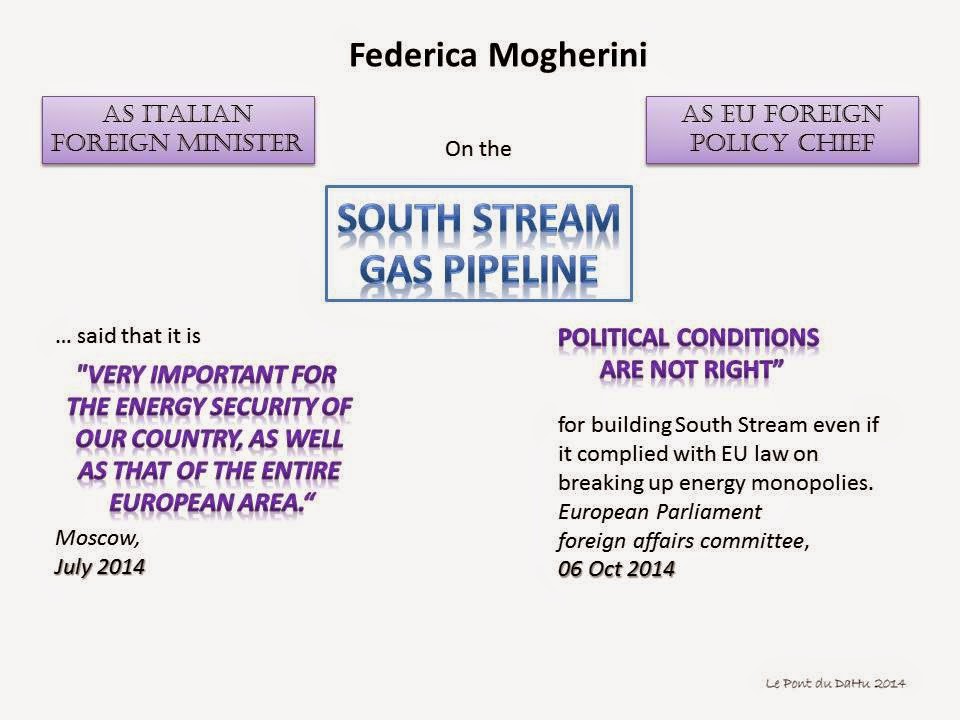
Countries involved with the South Stream project are quite unhappy with the EU's decision to suspend construction & have expressed their “commitment” to it.  The Italians, Austrians, Hungarians, Bulgarians & Serbians remain keen supporters of the project. Hungary & Serbia are now at odds with the EU due to their positions on the implementation of South Stream. Even the Italian government is concerned, as it wants to reduce its reliance on gas from  North Africa, (Libya!).  Italy's state secretary for European affairs, Sandro Gozi stated in an interview in July that:“We think South Stream should go ahead, as it would improve the diversification of gas routes to Europe.” He also added that was a need to first alternative solutions in"how to get fuels," before halting the South Stream project. Ironically so was Federica Mogherini before she became EU foreign policy chief.


Ironically, the EU had previously pushed for the creation of the Nabucco pipeline, connecting gas from the Caspian Sea to Europe. However, it did not receive sufficient political support for it to develop. The EU was not deterred by this setback as it is currently supporting another project - the TAP pipeline, again from the Caspian Sea via Turkey to Europe.  This would enable the EU to diversify its gas supplies, away from Russian gas.

The  knee-jerk reaction by the EU to favor the Nabucco or the TAP pipelines may seem to have some substance.  Nevertheless, it is equally short-sighted, since reducing Russian gas supplies would benefit greatly Turkey, as the alternative gas transit state to Europe. This could also have unforeseen consequences for the EU.  

The narrow focus on  Gazprom as a monopoly shows that the EU is fixated on Russia, since this is not the only monopoly that dominates the EU sphere, take for instance Amazon or Microsoft, who have an unequal slice of the pie.  However they come under less scrutiny than Gazprom these days. Is this a case of blinkered thinking on the part of the EU leadership?


The final word

Vaclav Baruska, the Czech Republic's energy security envoy said, "We simply expect either no transit or unpredictable transit this winter."  Prague evidently knows about the past habits of Ukrainian authorities, the level of corruption which could still jeopardise gas transit through Ukraine.

Background Info

GAS INFRASTRUCTURE -Main European routes are:

Nord Stream (Baltic Sea) with a capacity of 55 bcm per year,
Yamal-Europe (Belarus) – 33 bcm per year,
Soyuz (Ukraine) – 80 bcm per year
and Blue Stream (Turkey) – 16 bcm per year,

http://www.energypost.eu/everything-always-wanted-know-russian-gas-supplies-europe/

Notes:

*The European Union’s Third Energy Package is a legislative package for an internal gas and electricity market in the European Union. Its purpose is to further open up gas and electricity markets in the European Union.


*South Stream:  The project started in 2002, with first deliveries due in 2016, and it was  expected to be fully operational in 2018:
 a capacity of  63 billion cubic metres (bcm) a year;
2400 km in length;
15% of European gas supply market

*Matthew Bryza, director of the International Centre for Defence Studies:
 "Russia would also be jeopardising its long-term position as Europe's principal gas supplier, by allowing the US, Australia and Mozambique to gain a foothold in this lucrative market. Moreover, Russia cannot cut off natural gas flows without doing permanent damage to its own natural gas reservoirs. In short, Europe can do without Russian gas; it is Moscow that cannot afford to carry through its threat. European leaders should not argue themselves out of tougher actions to stop Mr Putin's military adventurism in Europe's east."


*The most likely sources of gas via the TAP would be Azerbaijan,Turkmenistan in the Caspian region, Iran, and the Kurdish area of Iraq. 

*Turkey is in fact one of the largest recipients of Russian gas, with an estimated 24.57 billion cubic metres (bcm) in 2013, which only roughly 10% less than the combined total Russian gas supplied for Austria, Hungary, Poland, Czech Rep & Slovakia.


Sources:

http://www.energypost.eu/mr-tusk-planet-live-century/

http://voiceofrussia.com/news/2014_07_01/Budapest-not-to-refuse-from-South-Stream-project-prime-minister-8032/ 

 Oxford Institute for Energy Studies (OIES),

 http://www.oxfordenergy.org/wpcms/wp-content/uploads/2014/10/NG-92.pdf

 http://www.eurotopics.net/en/home/presseschau/archiv/archiv_dossier/DOSSIER149684-Sanctions-against-Russia-divide-the-EU

 http://russia-insider.com/en/business_society/2014/11/12/09-03-49am/google_amazon_and_apple_less_transparent_gazprom


lundi 27 octobre 2014

Blog Hungary’s Orban under the microscope [eng]


Hungary’s Orban under the microscope


Is a US inspired “colour revolution” or so called “ regime change” going to take place in Hungary?


Apparently, those who constantly throw together new ‘colour revolutions’ consider themselves ‘brilliant artists’ and simply cannot stop. 
Vladimir Putin, Valdai Club 2014

The turning point 


There have been a number of moves by the US and the EU underfoot, putting Hungary under the spotlight for its apparent unwillingness to uphold democratic values.  Victor Orban has been the Prime Minister of Hungary 3 times and was re-elected again in April 2014 with a majority of just over 44%.


The alarm bells probably started ringing loudly in the US and the EU when Orban gave a speech on 26 July 2014, where he stated that “And so in this sense the new state that we are constructing in Hungary is an illiberal state, a non-liberal state.”  He did also mention “similarly to the statements I quoted for you earlier, was also categorised as blasphemy by the liberal world. We had to state that a democracy does not necessarily have to be liberal. Just because a state is not liberal, it can still be a democracy.” He also quoted as “The stars of the international analysts today are Singapore, China, India, Russia and Turkey.Nb1

 Orban’s speech focuses on the alterative systems to the US led hegemony on so called democratic values. The EU minister of Norway, Vidar Helgesen recently stated in a twitter that “Hungary is failing the democracy test -- and the international community finally seems to be taking action”.  Nb2
   

The US angle


It has become noticeable that the US administration lately is getting more and hotter under their collar with regards to Victor Orban. Why is this so?  The answer is principally is because of his public recalcitrance towards EU sanctions against Russia. Orban stated back in August that the EU sanctions were like ““shooting oneself in the foot.” Some possible context to why he said this:


  •        Around 80% of Hungary’s natural gas comes from Russia, (via Ukraine);
  •       2.55 billion euros worth of exports to Russia in 2013 alone- (exports potentially slashed);
  •       10 billion euro contract with Russia company to upgrade the Paks nuclear plant, (now potentially in jeopardy);
  •       Heavy involvement with the $40 billion South Stream gas pipeline project, (on hold)


The Hungarian Foreign Minister Peter Szijjarto recently stated that Hungary was losing over $200,000 every due to the EU sanctions against Russia.   Despite this, the U.S. Chargé d’Affaires André Goodfriend publicly voiced in a news conference last week, the fact that Hungary “"stand firm with the EU, with EU sanctions." Nb3 He also criticised the Hungarian government for its involvement with South Stream, as well as the Paks nuclear plant contract. As absurd as it may seems, but this is not the only US official to publicly rebuke Hungary and tell it on how to behave within the EU.  Previously, it was the turn of Victoria Nuland, the Assistant Secretary of State for European and Eurasian Affairs, back in September.  She lambasted Central Europe leaders, (and also taking a side swipe at  the Hungary government in particular) by saying “"How can you sleep under your NATO Article 5 blanket at night while pushing ‘illiberal democracy' by day; whipping up nationalism; restricting free press; or demonizing civil society?" Nb4


It is now very clear that the US administration is intensely hostile to the South Stream, only because of the source of the gas, Russia and not the route, since Andre Goodfriend said on the 24th of October: "We disagree with that approach, because we think that diversifying sources is what's important,” taking issue with the fact that Hungary is not trying hard enough to diversify its gas sources.  Two days previously, the Hungarian Parliament proposed new legislation on South Stream without the need for the EU’s oversight over this matter. Nb5


Washington and Brussels are furious about the Hungarian government’s moves concerning Russian natural gas imports. Hungary stopped the reverse gas flow to Ukraine, supposedly for “technical reasons”, which left Kiev literally out in the cold, and extremely unhappy.  This happened just a few days after Gazprom CEO Alexei Miller met Hungarian PM Orbán on 22 September in Budapest. No doubt both these events were viewed dimly by both the EU and the US. Nb6


“The presumption that we will fall into the arms of the Russian bear is pure fear-mongering. We are NATO and EU members,” Victor Orban, July 2014


Hungary is in both the EU and in NATO, has committed some troops to the NATO Readiness Action Plan (RAP) in Eastern Europe, and is also upgrading the Papa airbase as a NATO base.  Additionally; there was a controversy that rumbled on in Budapest regarding the sale of T 72 tanks to Ukraine, via the Czech Republic.

Yet, the EU/ USA Mainstream Media Network (MSN) have been spinning their stories on Hungary and Victor Orban ever since he first raised objections to the EU sanctions back in March. 

Orban is quoted by the Huffington Times article, (20/07/14), as being Putin’s “nationalist right wing allies in neighboring Hungary.” The article continues to state that “Orbán has cultivated ties to none other than Vladimir Putin who already seeks effective partition of Ukraine.”  [Ed’s Note: Could this be the same partition that Sikorski, the ex-Polish Foreign Minister mentioned but then later retracted as being untrue?]. Nb7


First came the veiled threats from the US Administration. Victoria Nuland said on  2nd of October:  I ask the same of those who shield crooked officials from prosecution; bypass parliament when convenient; or cut dirty deals that increase their countries’ dependence on one source of energy despite their stated policy of diversification.” Two weeks later, the US administration in mid-October signaled their displeasure by slapping a travel ban on 6 Hungarians officials, citing “Proclamation 7750” on corruption ‘issues’.  Although a Reuters article on the subject deftly turned this reason on its head and gave the reason as being “as a warning to Budapest to reverse policies that threatened to undermine democratic values.

Reportedly, Hungary is the only NATO ally to have been affected by such an US travel ban. The Hungarian government was left perplexed and considers the travel bans as groundless until the reasons are revealed by Washington.  Nb8 Nevertheless, it has caused a stir in Budapest, which was quickly followed up the comments of the U.S. Chargé d’Affaires André Goodfriend, who said that “Hungary should move from guessing who has been banned from entering the United States towards trying to find ways to co-operate with the U.S. in combating corruption.”


EU angle


The EU Norwegian minister, Vidar Helgesen,  allegedly said, “When the Hungarian government is challenging these values it challenges the EU itself.” The EU, who are said to be losing patience too and in October, there were glimpses of this annoyance. The EU Hungarian political scene was muddied when EU MEPs blocked the Hungarian nominee, Tibor Navracsics, for the post of Commissioner of education, culture, youth and citizenship. This was because of Navracsis' doubious record on supporting a "civil society" in Hungary.


The Trans-Carpathian dimension


Victor Orban visited Transcarpathia at the end of September, located in western Ukraine, home to about 162,000 Hungarians.  He gave a speech about Ukrainian relations: “We need a strong neighbor. We hope that there will be peace in your country. We want an open dialogue and are willing to cooperate and support. Our doors are always open for you, we will help to solve the problems that you announce". Yet this provoked a negative response from the US official, André Goodfriend, as he said that Hungary "to understand the sensitivities on the ethnic nationalism question."   This was an oblique reference to Hungary’s interests in Transcarpathia, amongst other regions.


A lot of the Trans Carpathian Hungarians voted for Viktor Yanukovich in the 2010 Ukrainian elections, which doesn’t sit well with the likes of the uber-Ukrainian nationalist groups ‘Svoboda’ or ‘Pravy Sektor’, who unsurprisingly took over some public buildings in the region and proceeded to trash them “Maidan square style”.  The serious threat of Ukrainian nationalism is of extreme concern to the Hungarian minority and consequently they are fearful for their future.


NGOs raided


At the beginning of September, the Hungarian authorities made moves against a number of foreign-back “civil society” NGOs based in Hungary, over alleged financial mismanagement. This triggered a wave of criticism including the Hungarian Civil Liberties Union (HCLU) who released a press statement with the following heading: “The EU Cannot Remain Silent About the Putinization of Hungary Any Longer”. Nb9

Two NGOs were specifically targeted, Ökotárs and Demnet, both connected to Norway NGO Grant, thereby provoking a diplomatic spate with the Norwegian government. Interestingly, Okotars is also the civil society implementing partner in Hungary of the U.S. Agency for International Development, (USAID). A week later, Hungary got a special mention in a speech made by President Obama back in September, where he said: “From Hungary to Egypt, endless regulations and overt intimidation increasingly target civil society.” The only EU and NATO country to be mentioned, along with the likes of Russia, China, Venezuela, Cuba and Burma.


The last word from the US


If that trend continues it may reach a level where the United States can no longer cooperate with Hungary as an ally.” Statement made by André Goodfriend.


The precedent has been recently set in Ukraine, where a democratically elected leader was violently overthrown, simply because he did not fit into the “international community’s democratic values”, by not respecting the wishes of the Maidan “civil society” groups and NGOs in February 2014. Indeed, the Euro-Atlantic bloc, along with the rest of the so called “international community” were so desperate to  bring in Ukraine into their sphere of influence, that they allied themselves with zealot anti-Russian ultra-nationalists and fascists Ukrainian groups. 


Internet Tax Protests


Not long ago, the Hungarian government proposed a new law on taxing the use of the internet, which has resulted in massive protests in Budapest on Sunday. The protest rally organizers of '100,000 against the Internet tax' have called the proposed law “anti-democratic” and also  described the proposals as the move  “… follows a wave of alarming anti-democratic measures by Orban that is pushing Hungary even further adrift from Europe.”


Moreover, protestors have attacked the offices of Orban’s Fidesz ruling party. All of the Western press has heaped criticism on Orban and his government.  Is this the start of a new Maidan in Budapest? 

It has come to my attention that one of the participants in Sunday's event is none other than Andre Goodfriend; was he merely an observer or was there more to his attendance. It seems that on face value, the US administration's signal is crystal  clear. Another noteworthy attendee was the ex Budapest mayor, Budapest Gabor Demszky from the SZDSZ party.  András Bencsik,
chief editor of the newspaper Demokrata, reacted to the event by comparing the rally to Ukraine: “football hooligans and liberals, just like in the case of the Kiyv Maidan”.Nb10

Another Twitter message of support came from none other than the EU  Vice-President of the European Commission Neelie Kroes:


The first shots of an US - Hungarian diplomatic fallout have already rung out in October.  Could the internet tax protest be the catalyst for what ultimately could be a US sponsored regime change, right in the heart of the EU and NATO hegemony?


 References and Notes:


  • Nb1a  http://www.kormany.hu/en/the-prime-minister/the-prime-minister-s-speeches/prime-minister-viktor-orban-s-speech-at-the-25th-balvanyos-summer-free-university-and-student-camp
    “    "This, Ladies and Gentlemen, is the explanation for the fact that the most popular topic in thinking today is trying to understand how systems that are not Western, not liberal, not liberal democracies and perhaps not even democracies, can nevertheless make their nations successful. The stars of the international analysts today are Singapore, China, India, Russia and Turkey.”

    1b -
http://hungary.usembassy.gov/pr_10182014.html
  

Nb 4  http://www.state.gov/p/eur/rls/rm/2014/oct/232444.htm


Nb 6 -  Interestingly, Hungarian officials cited that additional gas supplies were being stored in preparation for winter consumption, as well as for neighboring states to buy. Several days after this was announced, Dusan Bajatovic, the chief executive of Serbia's Srbijagas stated that it was looking to secure supplies from Hungary. Moreover, at that time, gas flow to Serbia was down by 20 percent. Interesting turn of events.

 Nb 7a -


7b  “He wanted us to become participants in this partition of Ukraine. ... This was one of the first things that Putin said to my prime minister, Donald Tusk, when he visited Moscow,” Sikorski was quoted as saying in a 19 October interview with Politico magazine.

Nb8-


Nb 9a

9b