In a world of universal deceit, telling the truth is a revolutionary act, George Orwell

Indignez-vous ! Stéphane Hessel

“Le courage c’est de chercher la vérité et de la dire ; c’est de ne pas subir la loi du mensonge triomphant qui passe, et de ne pas faire écho, de notre âme, de notre bouche et de nos mains aux applaudissements imbéciles et aux huées fanatiques ”.” – Djordje Kuzmanovic


Affichage des articles dont le libellé est Hungary. Afficher tous les articles

mardi 24 mai 2016

Post - EU & rest of world - liberal vs illiberal – the mark of Cain

The ideological battleground: liberal vs illiberal – the mark of Cain

The term liberalism has different permutations that render it complex. When viewed in the European context, liberalism is viewed by many as the driving force for the EU; it is seen as the antidote to nationalism & authoritarianism, a panacea of sorts.  A British paper, the FT, recently wrote about an arc of illiberal politics gaining ground through Poland, Hungary & to a lesser extent Slovakia & Austria. So much so, Hungary's prime minister, Viktor Orban stated in a speech in 2014 that he is an advocate of "illiberal democracy" as a response to Merkel’s comments that Hungary should pursue ‘liberal democracy”.

“The insistence by Orbán that he is Hungarian first, and Christian, deeply offended the internationalist and devoutly secular leadership of the EU. This was deviation from the founding principles, which were less about liberal democracy and more about a certain ideology within it.”

I’ve seen time after time, the peculiar use of illiberal as a word in discourse & policy papers. It is often linked to “illiberal surveillance state, policy”, “identity politics”, “regressive mindset”, or “illiberal governance”. Additionally the proponents of ‘liberalism’ are quite vocal about seeking a raft of sanctions or outright bans on challenges to their worldviews.   

Russia is regularly labelled as an “illiberal state”, because it contradicts the EU ideological stance. Illiberal democracy as a concept is seen as a serious challenge to the “European order”.  The amount time & energy that is spent by politicians & behind-the-scenes policy-makers alike, trying to police those states that dare to show an “illiberal streak” is mind-boggling & ultimately counter-productive.

There is a complete inability on the part of EU elites & the MSM to deal with opposing viewpoints with reasoned arguments.  The EU is supposed to be about having a robust policy on human rights & freedom of expression but instead it is slipping further into a near totalitarian dogma as evidenced by the fact that top-level decision makers are totally unaccountable & ignore the grassroots concerns of Europeans.  Moreover, even elected leaders act in a pushy manner, antagonizing Europeans in the process. One example where Mrs. Merkel has pertinently demonstrated this is by imposing her views to the Eastern European states on how to implement migrant policies.

Increasingly, EU policy-making decisions don't stand up very well to scrutiny and criticism, as can be seen with the raft of sanctions against Russia, which has effectively crippled large swaths of the European agricultural sector.  Another example is the chaotic & whimsical relationship between Turkey & the EU, overlooking the dramatic deteriorating of human rights in the region. The EU by its own nature is elitist, undemocratic & intolerant & has been steamrolling its ‘liberal values’ for several decades now.

Many Central & Eastern European states joined the EU with the anticipation of improved prospects & high expectations for their citizens economically & socially. An overlooked, issue is that most people in these countries are still quite poorer than their Western counterparts despite all of the EU achievements to uphold “liberal values”.  However, in recent years some countries, it could said that the people have a jaundiced view regarding these EU values that have proved to be hollow, as well as a feeling of having been deceived.  So something had to give.  The electorate voted in significant numbers for alternative political leaders, the MSM subsequently pulls out of its hat the ‘illiberal’ card. The MSM acts as a gatekeeper, by serving the interests of the elite, thus widening the gap between the European people   & EU institutions.  It also steadfastly applies the EU core ideology, based on “liberal values”, as one voice; they can easily intimidate & denounce opponents as ‘illiberal’ that try to move away from dogmatic EU policies set in stone.

 The EU 'liberals' who are:

  • cheering on the uncontrolled migrant waves into Europe; (without any consideration for upholding existing border controls & laws);

  • lending their support to so-called 'moderate rebels' in Syria, hell-bent on massacring their opponents;

  • shutting down freedom of expression & dissenting views, (mostly due to islamphobia concerns + due toTurkey's demands). No more placards with Je Suis Charlie).

  • backing of openly neo-nazi & fascists groups in Ukraine and turning a blind eye to 
    extrajudicial punishments & killings.

But keep playing the broken record of "iliberal democracies"!


Sidebar on freedom of speech in the EU: 1 Could Erdogan charge you for 'insult' in your country? http://goo.gl/t1EQmH

vendredi 20 novembre 2015

The EU, migrants & Visegrad 4


Hungry, Czech Republic, Poland and Slovakia are collectively known as the Visegrad 4 or V4, which will celebrate its 25th anniversary next year.  PM Orbán congratulated the new Polish PM, and urged "the necessity of more intensive coordination between Visegrad nations."

Back in August, the V4 countries caused a stir in the EU by throwing a spanner in the EU works by refusing to accept an EU wide quota on migrants.   The French Foreign Minister, Laurent Fabius responded by saying that this was "scandalous” and also said that the border barrier being built by Hungary at that time "did not respect Europe's common values".

[Ed-  I’m wondering what he has to say now that Slovenia’s is putting up its own border barrier, (sorry “temporary technical hurdles” in form of razor wired fences).   Or the fact that of Austria has constructed  its own fence on the border with Slovenia.]

Interestingly, the V4 countries did manage to shift Brussel’s position on quotas, as can been seen in their communique in September.
http://www.visegradgroup.eu/calendar/2015/joint-communique-of-the-150911  

On the ground, the Visegrad 4 countries are providing border patrols along the Hungarian border with Serbia.   This ties in with what Vitkor Orban stated recently that the EU must first establish its own lines of defence.

https://twitter.com/Kittensinurface/status/663438174618787840

http://www.defence24.com/271521,polish-border-patrol-units-in-hungary


There is still a deepening unease within the Visegrad 4 countries on the handling of the huge influx of migrants since late summer.  Hungary is acting in accordance with the Schengen Agreement that obliges countries with external Schengen borders to protect it from illegal crossings.  Yet the EU Commission countered a few times this by stating that Hungary was going against EU values!

"The commission does not promote the use of fences and encourages member states to use alternative measures," Natasha Bertaud, the European Commission's spokeswoman for justice and home affairs, in July.

http://www.rferl.mobi/a/european-commission-hungary-serbia-wall-fence-illegal-migrants/27079829.html

Recently they have deployed around 300 police officers to patrol the Greek – Turkish borders.

http://hungarytoday.hu/news/visegrad-countries-deploy-300-strong-joint-police-force-patrol-greeces-boder-turkey-21447 

The Hungarian president, Viktor Orban, is quite scathing about the EU leadership, especially in relation with Turkey.  Last week, in Malta, he said “We do not want the EU to sit down to negotiate with Turkey, while giving the impression that it is Turkey which will save the EU. One cannot negotiate if the other party thinks that they are their negotiating partner’s last hope”.

On one hand, the ‘rebellion’ by the Visegrad 4 seems to be a clear cut example of disunity within EU ranks.  On the other hand, it also seems that they are acting as a kind of lifebuoy for the whole EU by taking the initiative & micromanaging a response themselves. This potentially might backfire on them, if Brussels does in the long run doesn't take into consideration the V4 countries’ political agenda concerning the ‘migrant’ flow into the EU. The signals from Brussels are still erratic to say the least, with Berlin still taking the limelight but at the same time staying quite inflexible.

According to a German newspaper Politico, Merkel said  “Those who can consider themselves lucky that they have lived to see the end of the Cold War now think that one can completely stay out of certain developments of globalisation. It just strikes me as somehow very weird,” Merkel then said "“When someone says ‘This is not my Europe, I won't accept Muslims,' I have to say, this is not negotiable".  Merkel’s message from Germany didn't always reach a sympathetic audience. A Czech Republic newspaper, Mladá fronta Dnes, stated that it wanted Merkel to be replaced by someone “with a sense of reality” & then said that “We must quickly forget how Germany tried to force us and the other Visegrád states into obedience, how it threatened and insulted us.”

It is quite revealing how the V4 are effectively responding in their own way to the sudden influx of migrants, and did so quickly, albeit in small measured steps. While Berlin generates more hot air & seen to be doing practically nothing at all to stem the migrant flow, it seems that the V4 are putting talk, aka “jaw jaw” into real concrete measures by micromanaging a partial unified response to the ongoing challenges, yet still remaining within the EU framework.

Lately, a number of high level V4 politicians seem to be pulling away from Brussel’s position on several issues.  First we had Viktor Orban firmly nailing his political colours to the mast in a number of speeches, now we have Miloš Zeman, the president of the Czech Republic, with his latest defiant speech regarding dissent views, migrants and Islam.   Then of course, a political swing towards the right in Poland recently took place along with a change in policy direction.  So that leaves Slovakia.  Well, the Slovak President doesn’t seem to share the same memo as his other V4 politicians.   AndrejKiska said that the Visegrad 4 cannot become a "troublemaking bloc... with a 'blame it on Brussels' attitude".  Yet, Robert Fico, the prime minister took different line back in August:

"We strongly reject any quotas ... If a mechanism for automatic redistribution of migrants is adopted, then we will wake up one day and have 100,000 people from the Arab world and that is a problem I would not like Slovakia to have." And Fico also send that “"As long as I am prime minister, mandatory quotas will not be implemented on Slovak territory."

http://www.euractiv.com/sections/justice-home-affairs/slovakia-calls-visegrad-summit-oppose-migrant-quotas-317199

Looking at the wider context: George Soros, of Hungarian descent, apparently outlined a 6 point plan in which the following is stated:

“First, the EU has to accept at least a million asylum-seekers annually for the foreseeable future. And, to do that, it must share the burden fairly – a principle that a qualified majority finally established at last Wednesday’s summit.”

http://www.georgesoros.com/essays/rebuilding-the-asylum-system/

As if reading the Soros script, Brussels & Berlin did made calls to share the load out to all members of EU, through a quota system.  Notably the Visegrad 4 have officially stated that they are very unhappy at the 'political correctness' behind what they perceived as being 'failed' EU migrant quotas being imposed upon them.  The Hungarian Minister of Foreign Affairs and Trade, Péter Szijjártó, said “Efforts at political correctness, as well as hypocrisy, prevent some from admitting that this is not a migrant crisis, but mass migration”. Moreover he too alluded to Berlin’s initial handling of the migrant influx, when he said that it is unacceptable to make political statements which that can be interpreted as “invitations”.

The mandatory imposition of an EU –wide quota has now been openly challenged by all of the V4 countries, with Poland being the latest member to do so. The Polish foreign minister, Witold Waszczykowski, has recently expressed his concerns over the whole migrant EU quota issue, after the terror attacks in Paris.

Soros’s article specifically mentions Viktor Orban’s own 6 point plan, where he criticizes it since in his opinion it “subordinates the human rights of asylum-seekers and migrants to the security of borders, threatens to divide and destroy the EU by renouncing the values on which it was built…”    The sparring match between Soros & Orban is quite evident.  Orban is not apparently approved of by the EU elites for a while now.  The MSM, right from the very beginning of the migrant ‘crisis, has been highly critical of the Hungarian government’s move in trying to the situation.  Now we can see that the V4 countries are lending a hand to Hungary.   Will this on-going political saber-rattling have wider repercussions on the V4 countries as a whole? Will Brussels be rattled by Orban and also V4’s general political direction?

The reality is that the V4 countries are not only deepening their cooperation between themselves but also wider across with Balkan countries. The Visegrad countries are currently holding a meeting in Prague along with Western Balkans states.  It is interesting to note that Slovenia is increasingly participating in the V4 group, but it is not as a member though. Also noteworthy was a trilateral meeting between Greece, Bulgaria & Hungary at the beginning of November.

While Brussels & Berlin appear to be totally frozen like a rabbit in the lights of a car, the V4 countries are continuing to establish & consolidate their political agendas and measures.

mercredi 3 décembre 2014

Blog post Orban Hungary & US arm twisting (eng)


Orban is accused by the US of openly ‘flirting’ with Russia.  Likewise, he is also accused in the press of moving Hungary away from “European Values”. The word out on social networks that another “color revolution is in the making” in Hungary.  The question being asked: is Orban going to share the same fate as Yanukovych of Ukraine? Simply for not wanting to kowtow to the US administration’s wishes. Orban has clearly nailed his political colors to the mast back in the summer;  to put Hungary first & foremost, to care about the sovereignty of Hungary & to give Hungary a voice of its own choosing, yet at the same remain in NATO’s & the EU orbit.  He vowed to turn his country into an “illiberal state”.  This does not sit well with the US & EU leaders, simply because it does not fit into the precepts of what the so called “international community” is about.

The US Administration's line is that Hungary "is on the verge of ceding its sovereignty to a neo-fascist dictator getting in bed with Vladimir Putin" as said by McCain in a Senate meeting on
Tuesday 2nd Dec.
Internet image about Hungary: source Twitter
Orban has not been shy to voice his concerns with regards to the risky & rash geopolitical events taking place in the corridors of Washington, Brussels & Moscow.   This has made him an easy target for the US, EU press to label him as being pro-Russian & pro-Putin as well.  The US & EU leadership has been looking for a well-timed excuse to flag up Orban’s lack of democratic credentials. This they found in the form of an alleged tax corruption ‘scandal’, as well as a police raid on several NGOs back in September.

At the end of October, the ruling government in Budapest unwittingly handed their opponents a golden opportunity, to stir up public discontent.   The proposed introduction of an internet tax charge was sufficient enough to trigger visible public protests at the beginning of November.  The Hungarian government subsequently back away from the tax proposals, but the protests then muted into anti-corruption protests. The latest protest on the 17 November was dubbed "Public Outrage Day" & was attended by tens of thousands of protesters.  

The Hungarian government has tried to respond to the US complaints of tax corruption.   The US charge d’affaires,  André Goodfriend, has been invited to clarify the US position at a parliamentary committee.  Yet, the US Administration refuses to divulge further information on the six Hungarian nationals connected to the Hungarian government, who have been banned from entering the US. ,  André Goodfriend is quoted in the press that “he has refused Hungarian government entreaties to give details, citing U.S. privacy laws”. 

As if on cue, the MSM press, in unison, has been highly vocal in their criticisms of Orban’s government; very frequently referring to his supposedly pro-Putin policies & pro-Russian attitudes. Likewise, Viktor Orban has been conveniently labelled as some kind of tyrant, with words such as Viktator”, “Orbanistan” & “The Goulash Archipelago “being used.

A potential clue as to why protests continue to take place could be the fact that the Hungarian government has not backed down on its eager support for the South Stream gas pipeline project, to the dismay of both Washington & Brussels.  There is unwillingness on the part of Budapest to simply toe the US line on severing pro-Russian policies, including that of the South Stream gas pipeline, reverse flow gas supplies to Ukraine & contracts for nuclear power plants. Why is this so? well  as Orban himself said in November that  “we don’t want to move closer to anyone, nor do we want to distance ourselves from anybody”.   This can be clearly glimpsed in his visit to Azerbaijan on the 11th November, where he said that it is in the interest of both Hungary and Europe to bring Azerbaijan gas to Central Europe.  This went almost unnoticed by the EU press, apart from a few who saw this as being part of Orban’s “clever games”.

Orban asserted that, “the presumption that we will fall into the arms of the Russian bear is pure fear-mongering. We are NATO and EU members.” This message has fallen on deaf ears in Washington & Brussels. Take for example Victoria Nuland’s speech in Budapest, in September, where she stated: “"How can you sleep under your NATO Article 5 blanket at night while pushing ‘illiberal democracy' by day; whipping up nationalism; restricting free press; or demonizing civil society?

It remains to be been seen for how long can Orban face up to the ever increasing pressure being subtly applied by the US & EU.   Although the end of South Stream project was annouced by Russia, it will not prevent Orban from being put under ever increasing scrutiny for "getting into with Putin".

Last word

“He is the only Putinist governing in the European Union,” said Joschka Fischer, the former German foreign minister.

Sources:


mercredi 12 novembre 2014

Blog: The light at the end of a pipeline? (eng)


The EU, Russian gas wars - (with a little help from the US)


The EU is determined in reducing its energy dependence on Russia gas, regardless of the political costs involved. The EU fears it is open to blackmail by Russia, rather than being seen as a source of revenue.  This fear has intensified as a result of the tensions in Ukraine, despite the 40 years of trade between first the Soviet Union & now Russia. Russian gas supplies to Europe could be reduced by using other alternative energy supplies, but at a high cost.  Equally, EU members states are tangled up with their EU environmental rules.  For instance, Germany itself is moving away from using coal, thereby potentially needing more gas supplies, as well as renewable energy sources to make any shortfall.  The key potential winner & loser in this energy gas security tug of war is Russia.  There are drawsbacks to all of the EU proposals for reducing dependence on Russian gas. 


In autumn 2013, the nerve centre of the EU, the European Commission, started an investigation into the South Stream pipeline project, as it was seen to violate the provisions of the European Union’s Third Energy Package.  This EU rule is designed to stop monopolies, as well as  promote competition & diversification between energy suppliers and transit routes.  This would require a separation in ownership as well.

South Stream project
The EU insistence that any new or amended contracts with Gazprom, need to be subject to the provisions of the Third Energy Package, is proving to be a big headache for the Russian supplier.  This opinion seems to be at odds with the comments from Donald Tusk, President of the European Council,  who stated that "Europe should confront Russia’s monopolistic position with a single European body charged with buying its gas"; effectively one monopoly versus another one, at the expense of each EU member state.

The contested element of the Third Energy Package is that half the capacity of the pipeline is required to be made available to independent suppliers.  The snag in all of this the pipeline is mostly financed by Russian money & Gazprom is the sole supplier & owner.  Thus it would need a special EU exemption to ship gas to Europe. Interestingly similar lively debates took place over the construction of the South Stream's twin, the Nord Stream pipeline, in the Baltic.

In March 2014,The European Commission decided not to exclude part of Nord Stream's pipeline, Opal, ( the German section), from the Third Energy Package. The result is that a 50% pipeline capacity has been set to allow other suppliers to use it.  The problem is no-one else has taken up the spare capacity on the pipeline. Additionally, due to the ongoing geopolitical tensions between the EU & Russia over Ukraine, the European Commission has pushed back the application for an exemption, until January 2015.

Of course, none of this would be the geopolitical hot potato that is it is now, if it wasn't for Ukraine, since it is seen to be a high risk for transit of Russian gas, principally due to the "gas wars" of 2006 & 2009, which left the EU in a highly vulnerable political & energy crisis.  
The tensions in Ukraine is driving the EU to take more action against Russian gas supplies. There is also increasing perception in Brussels & Washington that Russian gas is Putin's choke-hold on the EU.   

The construction of South Stream would negate the Ukrainian transit risk, but so would the political leverage of Ukraine as a transit country. Clearly both the US & the EU are aware of this and hence the EU 'spanners' are being put into the works of the South Stream project, quite probably at the behest of the US Administration.  A glimpse into the US administration's mindset was given by the Hungarian Prime Minister, Vitkor Orban, this week, when he said that the US  was putting pressure on the Hungarian government over the South Stream pipeline.  More direct are the words of Matthew Bryza, the former US ambassador to Azerbaijan, who suggested that:" ‘Europe can do without Russian gas; it is Moscow that cannot afford to carry through its threat.’ President Putin recently remarked that the South Stream delays were of a political character. 

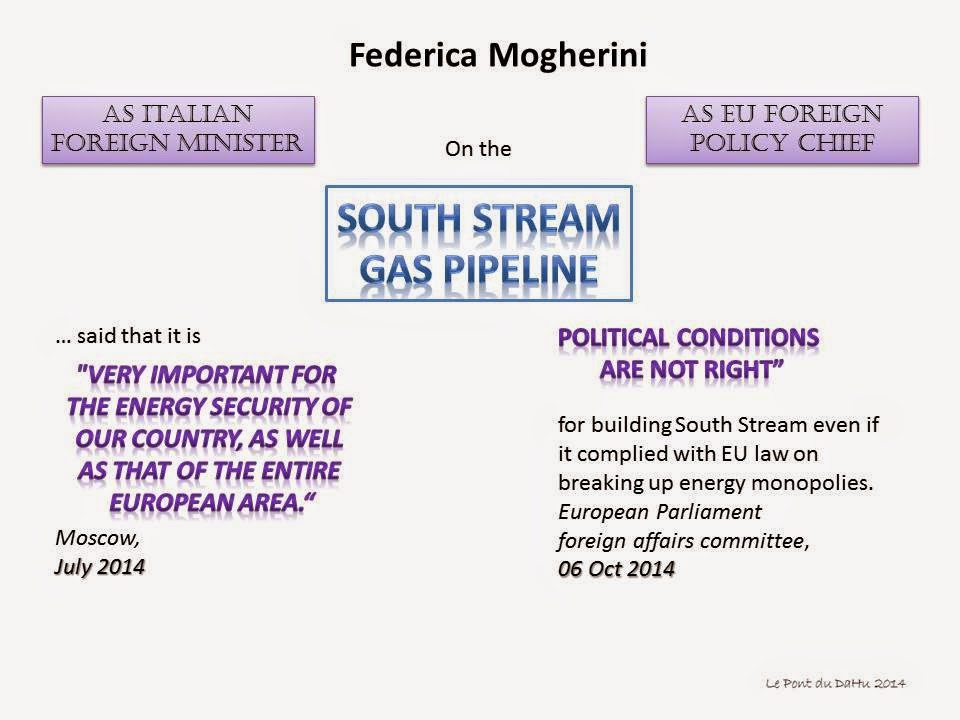
Countries involved with the South Stream project are quite unhappy with the EU's decision to suspend construction & have expressed their “commitment” to it.  The Italians, Austrians, Hungarians, Bulgarians & Serbians remain keen supporters of the project. Hungary & Serbia are now at odds with the EU due to their positions on the implementation of South Stream. Even the Italian government is concerned, as it wants to reduce its reliance on gas from  North Africa, (Libya!).  Italy's state secretary for European affairs, Sandro Gozi stated in an interview in July that:“We think South Stream should go ahead, as it would improve the diversification of gas routes to Europe.” He also added that was a need to first alternative solutions in"how to get fuels," before halting the South Stream project. Ironically so was Federica Mogherini before she became EU foreign policy chief.


Ironically, the EU had previously pushed for the creation of the Nabucco pipeline, connecting gas from the Caspian Sea to Europe. However, it did not receive sufficient political support for it to develop. The EU was not deterred by this setback as it is currently supporting another project - the TAP pipeline, again from the Caspian Sea via Turkey to Europe.  This would enable the EU to diversify its gas supplies, away from Russian gas.

The  knee-jerk reaction by the EU to favor the Nabucco or the TAP pipelines may seem to have some substance.  Nevertheless, it is equally short-sighted, since reducing Russian gas supplies would benefit greatly Turkey, as the alternative gas transit state to Europe. This could also have unforeseen consequences for the EU.  

The narrow focus on  Gazprom as a monopoly shows that the EU is fixated on Russia, since this is not the only monopoly that dominates the EU sphere, take for instance Amazon or Microsoft, who have an unequal slice of the pie.  However they come under less scrutiny than Gazprom these days. Is this a case of blinkered thinking on the part of the EU leadership?


The final word

Vaclav Baruska, the Czech Republic's energy security envoy said, "We simply expect either no transit or unpredictable transit this winter."  Prague evidently knows about the past habits of Ukrainian authorities, the level of corruption which could still jeopardise gas transit through Ukraine.

Background Info

GAS INFRASTRUCTURE -Main European routes are:

Nord Stream (Baltic Sea) with a capacity of 55 bcm per year,
Yamal-Europe (Belarus) – 33 bcm per year,
Soyuz (Ukraine) – 80 bcm per year
and Blue Stream (Turkey) – 16 bcm per year,

http://www.energypost.eu/everything-always-wanted-know-russian-gas-supplies-europe/

Notes:

*The European Union’s Third Energy Package is a legislative package for an internal gas and electricity market in the European Union. Its purpose is to further open up gas and electricity markets in the European Union.


*South Stream:  The project started in 2002, with first deliveries due in 2016, and it was  expected to be fully operational in 2018:
 a capacity of  63 billion cubic metres (bcm) a year;
2400 km in length;
15% of European gas supply market

*Matthew Bryza, director of the International Centre for Defence Studies:
 "Russia would also be jeopardising its long-term position as Europe's principal gas supplier, by allowing the US, Australia and Mozambique to gain a foothold in this lucrative market. Moreover, Russia cannot cut off natural gas flows without doing permanent damage to its own natural gas reservoirs. In short, Europe can do without Russian gas; it is Moscow that cannot afford to carry through its threat. European leaders should not argue themselves out of tougher actions to stop Mr Putin's military adventurism in Europe's east."


*The most likely sources of gas via the TAP would be Azerbaijan,Turkmenistan in the Caspian region, Iran, and the Kurdish area of Iraq. 

*Turkey is in fact one of the largest recipients of Russian gas, with an estimated 24.57 billion cubic metres (bcm) in 2013, which only roughly 10% less than the combined total Russian gas supplied for Austria, Hungary, Poland, Czech Rep & Slovakia.


Sources:

http://www.energypost.eu/mr-tusk-planet-live-century/

http://voiceofrussia.com/news/2014_07_01/Budapest-not-to-refuse-from-South-Stream-project-prime-minister-8032/ 

 Oxford Institute for Energy Studies (OIES),

 http://www.oxfordenergy.org/wpcms/wp-content/uploads/2014/10/NG-92.pdf

 http://www.eurotopics.net/en/home/presseschau/archiv/archiv_dossier/DOSSIER149684-Sanctions-against-Russia-divide-the-EU

 http://russia-insider.com/en/business_society/2014/11/12/09-03-49am/google_amazon_and_apple_less_transparent_gazprom


dimanche 9 novembre 2014

Blog - post on Orban speech 8 nov 14


SEE ALSO:

 ****************************************************************************

Machine translation from Hungarian

ENG DRAFT   - En français plus bas.

Concern For Europe

8 november 2014.

Viktor Orban's thoughts about Helmut Kohl: "Concern for Europe – an invitation to" based on the book.

The anniversaries such as the carpet bombing: lessons of us treasures. The anniversary of the fall of the Berlin wall and the opening of borders under the German újraegyesítésnek 25. Anniversary Special actuality lends to its the just released book, which is the XX. a large 19th-century history can shape, Helmut Kohl's personal experiences, and even includes a political programme. The subtitle of the book clearly articulates: "Invitation", that is, the book is none other than the former German Chancellor's offer of joint action. The great German politician from burning unto the end, the idea of Europe, permeated by a common destiny, a shared responsibility, which we need to sense and érzelemvezérelten.

According to the author of peace and freedom in Europe, it also abandons the prerequisite for everything else: democracy, rule of law, protection of human rights, social stability and prosperity, the responsibility for Europe and for the world wore. I share the Chancellor's Lord meglátásában. My belief is that the Union is not some utopian obsession, but also a very real, tangible, practical aim — brought to life: (a) the need for the establishment of peace. This claim is nothing utopian. The XX. century against dangerous and failed utopia was born out of the idea of European unity is very practical.

Kohl also highlights the current trends, which are considered a matter of concern. At the root of the problems, unrelenting bad decisions. A summary of the not-so-positive: "Europe is not in a good position." The reasons for the Chancellor of the high correlations for numbness, the kishitűségben, the válságszónoklatban, the continuous and far-sightedness when dealing with the history of ignorálásában see. And how is the XX. most witnesses to the 20th century, the 21ST CENTURY. the Europe of the 21st century. For us, the makers of this we need to understand that for the European Union, the question of whether that is added to the history of misguided utópiáinak line. If you're not careful, I mean, the Union may later revealing misguided utopian experiments. It is our responsibility, that this does not happen.

Helmut Kohl is one of Europe's great építőmestereinek, who together with European partners, during the mandate of the Chancery, he worked tirelessly for the continent of újraegyesítésén. Writing a number of answers to that question, which is what Hungarians are also directed to the study of the European process. The book also points to a help in a hurry, where you might not expect. Remember, today representatives of the same political forces are worried about Hungary, "roll the European values has occurred" due to, who, as the Chancellor Kohl's book also reveals the time-is a major obstacle in the short term political benefits on the altar of economic and financial stability in Europe, the murderer and the reliability of foreign policy as well.

For us, it is also important for Hungarian readers Guide to the small Member States are worth just as much as the big ones, in his opinion, látásmódjuk the construction of the European Community it serves. Chancellor Kohl, together with the Lord, I believe that the main values of the Nations of Europe, even the diverse Nations. In Europe, the Nations of the United States, the reality of the utopia. Utopia here in Europe. Because there are thousands of years of national roots, which would cut equal to suicide.

I am convinced that the Nations should be more involved in the work of the Union. Decades-old institutions do not operate in the framework of a centuries-old human coexistence. Doomed, if we want to create a Europe without national characteristics. No one has the right to it, implying that the wish to abdicate your own identity. We agree with the Chancellor, the Lord: do not want to separate, bureaucratic, centralized management and "mammoth institution." The institutionalized Europe cannot diverge further from the Member States and the citizens. We here in Europe we are all rooted in a commitment to Christian values and we are part of. The Chancellor Lord boldly States: Europe is not some dreamy idea, no poems, no folklore. Not the dreamers to build Europe, and therefore we can not cheers for Europeans.

The challenges and the problems it confronted, inexorable egyenességgel in search of the good answers. To do this, but we need to know what we want. It is necessary for the purpose of humility, a clear and unambiguous vízióra and the direction of policing and we are able to keep a strong political leadership. So we get to the common action for Europe to worry for her use. Thanks Helmut Kohlnak!

Viktor Orban